Three years ago, Varun Gupta introduced me to an incredibly talented evolutionary biologist and entrepreneur, Sam Levin. One day, while sipping a coffee in his 400sqft East Village apartment, I asked him what I thought was a straightforward question: why do we make our medicines in Chinese hamster ovary cells? Trying to answer that seemingly innocuous question changed the course of both our lives; and, we think, the future of biomanufacturing.
A recovering aerospace engineer, I had spent 4 years building self-driving car technologies, yet I felt the most exciting things were happening at the intersection of Tech+Bio. Sam, meanwhile, had built a company at the heart of this revolution. We shared a common belief that AI will have its largest impact in improving human health. But despite all the progress in designing new medicines, are regressing in manufacturing these scalably, affordably, and resiliently, to the point where it is now a major bottleneck in making existing medicines accessible and getting breakthroughs to patients.
To eliminate this bottleneck, Sam and I realized we would have to reinvent biomanufacturing from the ground up. Today, after two years of building quietly, we’re introducing Neion Bio.
Synthetic biology has promised a world in which our local farms produce not just the food in our grocery stores but the medicines in our hospitals. But for the longest time we have tried to strip away the complexity of biology, to tame it, in order to get it to do our bidding for us. For over fifty years we have manufactured bioproducts in giant steel tanks, in capital intensive industrial facilities. In 2025, while AI accelerates our ability to design drugs, our critical medicines are still incredibly costly, take years to scale, and depend on complex and fragile supply chains, increasingly located outside the US.
We founded Neion Bio to change that – to dramatically lower the cost of life-saving medicines, reduce drug shortages, increase resiliency, and enable the localization of critical medical supply chains. Building this company, we knew, would require recruiting one of the world’s best genome engineers. Over croissants at Lafayette Bakery in SoHo we became convinced that this person was Sven Bocklandt. A few months later, we met long-time pharma industry leader Ming Li, who shared our conviction that unseating decades-old infrastructure was not only possible, but necessary. Meanwhile, we were lucky enough to be backed by incredible investors – Varun Gupta and Ray Tonsing (who not only introduced us but led our pre-seed and seed), Lan Xuezhao and John Mannes (our stellar thought-partners), Semil Shah, Aashay Sanghvi, Packy McCormick, Elliot Hershberg, Robert Pollak, Michael Polansky, Ben Savage, Josh Zoffer, Kyle Schneider, Sarah Meyohas, Srikar Varadaraj.
Today, with the help of Carl Zimmer and The New York Times, we are proud to present to the world a new type of bioreactor. This bioreactor harnesses the complexity of evolution rather than stripping it away. It is fully autonomous, self-replicating, and capable of printing virtually any protein for a fraction of the cost of today’s systems. It can be operated without expensive equipment or facilities, and it runs on entirely localized inputs, which are all abundant in the US. It can be expanded to meet global demands without scale up risk. It can even self-assemble to produce high purity, complex biotherapeutics.
Perhaps more remarkably, the infrastructure needed to run these bioreactors already exists, in nearly every country in the world, and in every state in America.
Building this platform required recruiting some of the world’s leading genome engineers and cell biologists, utilizing frontier genetic engineering and stem cell technologies, as well as inventing some of our own.
But the heart of our system is 200 million years old. And it should be deeply familiar to all of you.
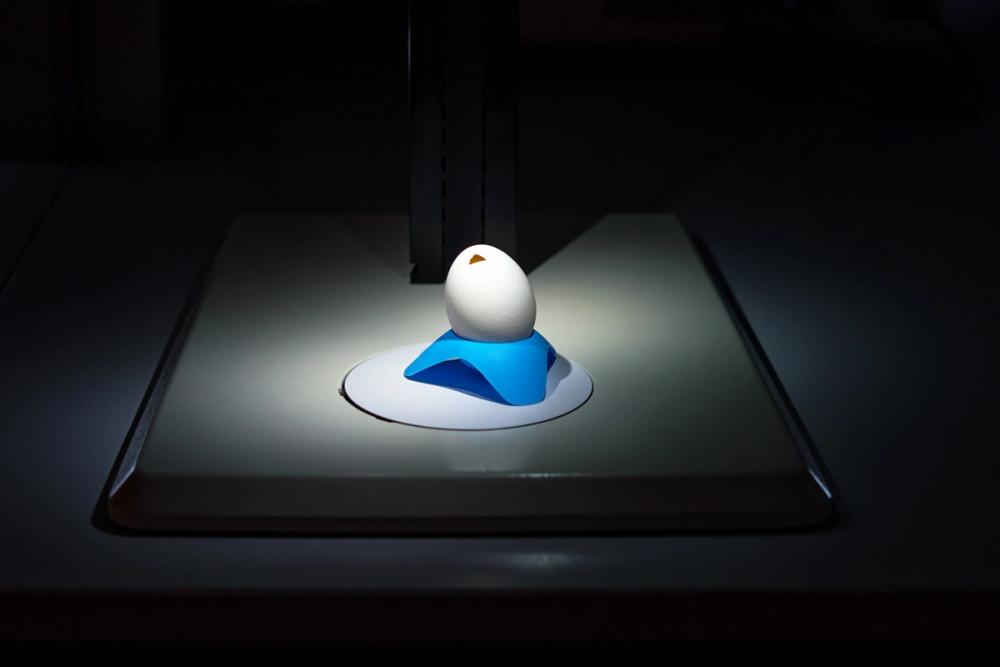
(Re)-introducing, the egg: